Edward and Ora Gridley House
409 E. Grove
In 1885, Edward Gridley, son of Asahel Gridley, built the home at 409 East Grove Street for his bride, Ora Walton. Designed by well-known local architect George Miller, the house cost $10,000 to build. Edward and Ora were divorced in 1903, and Ora acquired the house in the settlement. The house was sold that year to John Mather Foster of Shirley, Illinois, one of McLean County’s pioneer families.

John Mather Foster, circa 1903
John Foster was married to Alice King, with whom he had four children: Alice, John, Irene and Ivan. Daughter Alice married Huber Light in 1903 and the newly-married couple made their home at 409 E. Grove St., along with her parents. Of interest to the home’s history, Huber’s sister, Margaret Light, became the well-known actress, Margaret Illington. She married Major Bowes of the Original Amatuer Hour, Capitol Theater and Metro-Goldwyn in New York City and was a frequent visitor to 409 E. Grove. Alice and Huber had 2 children, Alice and Ivan. In 1934, Alice Light married Lee McTurnan and they in turn lived at 409 E. Grove St. and raised their son Lee, Jr., there. Lee McTurnan Sr. died in 1982, and his widow died in 1996. Remarkably, the house stayed with the same family through 3 generations, all of which cared for and maintained so much of the house’s details, both exterior and interior. In 1997, it was purchased by John Elterich and Karen Schmidt for their family residence. They have continued the commitment to preserving the home.
409 E. Grove - Alice McTurnan
According to details provided by Alice Light McTurnan, there was a high board fence at the rear of the property on Olive Street that included a huge double gate. The brick access is still intact in the parkway on Olive St. Board fences, about five feet tall, lined the sides of the property. No barn was ever built there; horses and a carriage were stabled nearby. The current garage was built in the 1920s.
As a country man with farms at Shirley, John Foster did not care for city water and decided to drill a deep well near the rear door. The pump stood intact for years, although the water was no longer used, reportedly for its bad taste. Around 1918-1919, the water pipe was pulled up enough to hit a gas vein that had been discovered from drilling for water. Gas was then hooked up to a furnace and was used to heat the house for several years. However, when it was cold, the gas pressure would go down and - without any means to regulate the flow - small explosions occurred. John Foster’s widow, Alice King Foster, who continued to live in the house, became increasingly alarmed by the explosions and the line was pulled and capped. The house was then converted to the more modern and popular Williams Oil O’Matic.
There have been no significant structural changes to the house. Missing is the metal sunflower atop a long stem that was attached to the top of the turret. In addition, the original ornate chimney tops were not replicated when repairs were made. The house was originally painted in the same colors that are now seen. The porch ceiling has always been a shade of light blue. The stained glass windows are original, as is the woodwork. The woodwork is grained throughout the first floor to simulate different woods.

Original decorative metal work
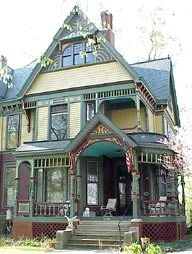
409_E_Grove
A fire on the second floor around 1916 destroyed the original wood-panel encased porcelain bathtub and sink that were decorated with floral motifs. At an unknown date, gas lighting fixtures were replaced with electricity. The current owners restored the original colors to the exterior, based on earlier wood scrapings and in consultation with the McLean County Museum of History.
Thanks to Alice Light McTurnan and Greg Koos for details regarding the home’s history.